

An AI-driven client portal that lets customers find answers themselves, day or night
The work that comes back every week and nobody misses: take it out, let it run, and never look at it again.
Ask a board where the hours go and you hear something about meetings or new business. Ask the people doing the work and you hear something else: data retyped from one system into another, a document assembled from scratch every time, a status that has to be updated by hand in five places.
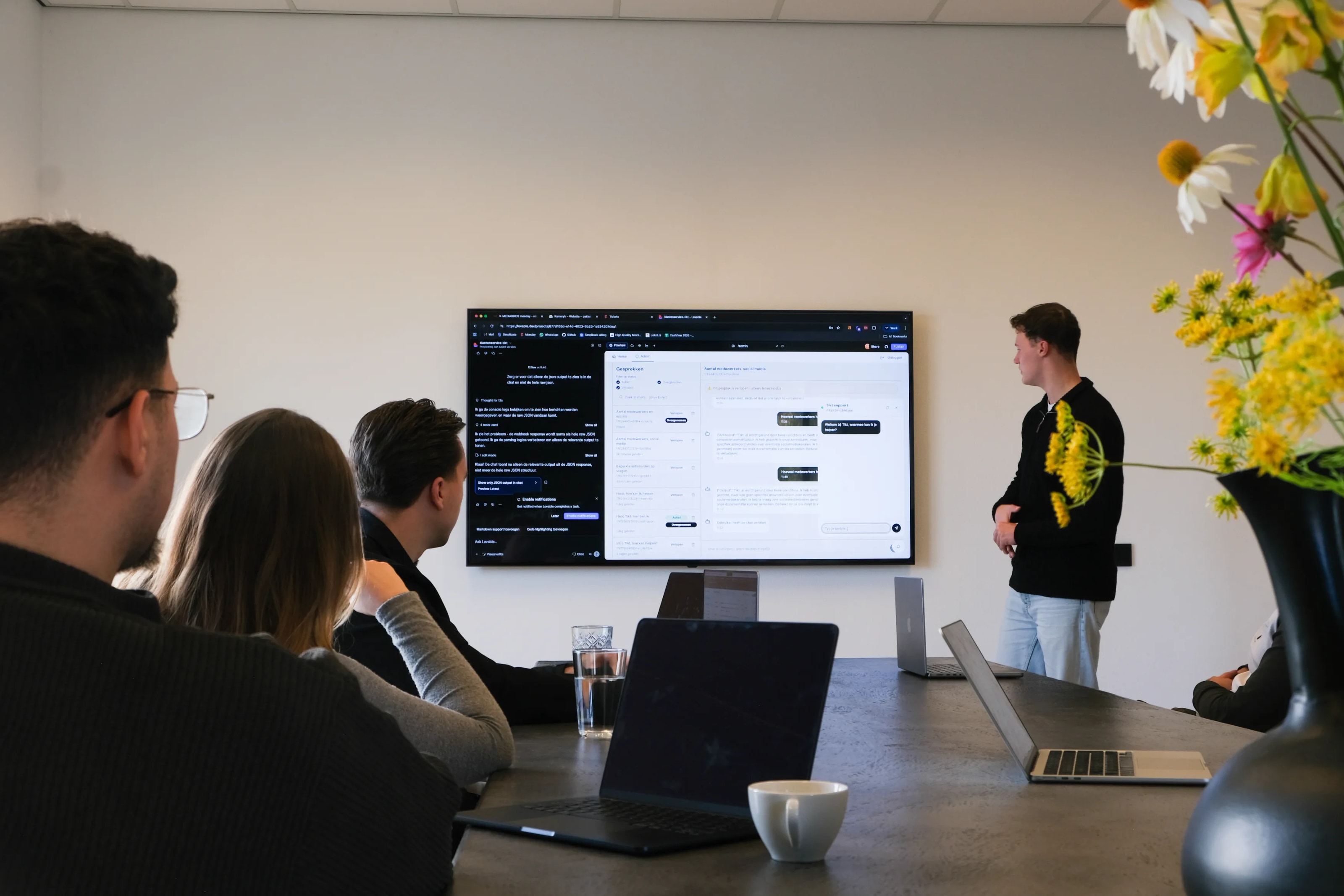
That is where automation pays off fastest. So a project with us starts by watching. Half an hour beside someone doing the work tells you more than a day-long workshop.
An AI-driven client portal that lets customers find answers themselves, day or night

Onderwijsregio Foodvalley
A platform with an API integration and an AI chatbot, put to work against the teacher shortage
Where this was part of the work
01 / 02
A process that comes round fifty times a week and costs four minutes each time is worth more than an impressive idea that comes up once a quarter. Frequency beats complexity, and it has another advantage: you see within weeks whether it works.
If it works, we hang the next process off it. If it doesn't, you know quickly and cheaply. Both are a gain. Building something large for a year and only then finding out it doesn't fit is not.
Brands whose processes we keep running



























































The moment a system does something on its own, you want to know what it did and why. So we always build visibility in: a log, an alert when something fails, and a person with the final word where that belongs. Failing silently is the worst thing an automation can do.
And the people who have to work with it are at the table from the start. They know which exception comes past every month, and that is what an automation trips over.
Not answered here? Ask the AI in the top right, or call us.
With one process that comes back every week; the strategy comes later. A first conversation usually surfaces two or three that could go without much work. That is where we start, and the rest follows once that is running.
Usually, yes. We build ourselves and are not tied to one tool or supplier, so we connect to what is there. If your administration runs on something old, that is one more integration. You don't have to tear up your whole landscape.
Then you need to know. Every automation we build keeps a record of what it did and raises an alert when something fails instead of going quiet. Where a mistake is expensive, we build in a check where a person has the final word.
A first, clearly bounded process is often live within a few weeks. That is deliberate: we want you to see quickly whether the approach works in your situation, rather than building for months on something that only gets tested at the end.
In practice we mostly see people doing different work: less retyping, more time for clients and for the work that calls for judgement. That is not a promise about your situation. What we do see is that automation which starts with work nobody misses rarely raises that discussion.
0
digital partnerships
0
years of experience
0
specialists on the team
0+
collaborations
A process that changes every quarter is a process you automate twice. A decision that calls for judgement is not one to hand to a system. And automating a messy process mostly makes it messy faster. That is rarely what you want.
So in that first conversation you also hear what we would leave alone. Sometimes the answer is that you need to clean something up first, and sometimes that the manual work should stay manual.
What costs you time every week?
Name one process. We'll tell you whether it can go.
Half an hour with the people who do the work is enough to see where it chafes. And if the answer is that you don't need us, you'll hear that too.
Free check·30 sec
How visible is your website?
Over twenty checks on SEO, technology and whether an AI model can quote you.